
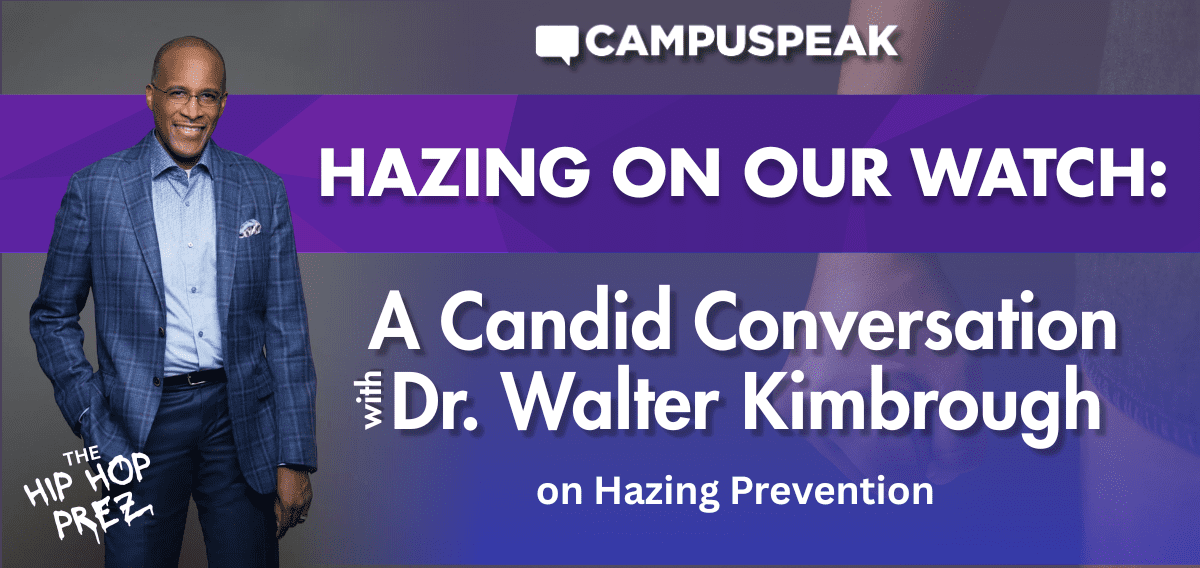
What It Actually Takes to Address Hazing with Dr. Walter Kimbrough
The Hip Hop Prez didn’t hold back — here’s what every student affairs professional needs to hear.
Hazing isn’t getting worse. We’re just getting better at talking about it.
That was one of the most important reframes that came out of our recent live webinar, Hazing on Our Watch, featuring Dr. Walter Kimbrough — former HBCU president, author of Black Greek 101, expert witness in hazing cases, and one of higher education’s most trusted voices on this topic. Over the course of an hour, Dr. Kimbrough sat down with CAMPUSPEAK co-founder and president David Stollman for a conversation that was equal parts historical context, practical guidance, and straight talk.
If you missed it, the full recording is available on YouTube. And if you were there, here’s a recap worth sharing with your team.
Hazing is a 600-year-old problem. Treat it like one.
Dr. Kimbrough traced hazing back to German universities in the 1400s, making a point that tends to get lost in the urgency of today’s headlines: this isn’t new. What is new is our ability — and our responsibility — to talk about it. Social media, federal legislation, parent advocacy groups, and increased media coverage have all raised the profile of hazing in ways that can make it feel like the problem is exploding. Dr. Kimbrough pushed back on that instinct. “I always just said, no,” he noted. “I think we’ve gotten a lot better about talking about it, about making it easier for people to report.” More cases being reported is a sign of progress, not failure.
For new professionals: trust your spidey sense — and understand your liability.
Dr. Kimbrough had some of his most pointed advice for newer student affairs professionals, who often carry the most direct relationships with student leaders. His guidance: build those relationships, stay close to the ground, and don’t dismiss your instincts when something feels off. “Don’t explain it away,” he said. “Take action and make sure that somebody else also knows.”
He was equally direct about the stakes. Drawing on his experience as an expert witness, Dr. Kimbrough reminded newer professionals that their actions — or inaction — carry institutional weight from day one. “They don’t care that you just graduated a year or two ago,” he said. “When you accept that kind of role, you have to understand that there’s a different level of responsibility.”

For mid-level professionals: you’re the traffic cop — and the expert.
Directors, assistant deans, and others in mid-level roles have the most complex job in the hazing prevention ecosystem, according to Dr. Kimbrough. They’re managing up, managing down, and navigating a wide range of constituencies simultaneously — student leaders, coaches, RAs, advisors, the conduct office, alumni, national headquarters staff, campus police, and parents. His advice for managing all of it: be the most knowledgeable person in the room, err on the side of over-communicating with your supervisor, and never let a potential issue become a surprise. “There’s a way to frame it so that it’s not a five-alarm fire out of nowhere,” he said. “I’m checking into something, I’ll circle back if it’s nothing.”
For senior professionals: know enough to ask the right questions.
One of the most quotable moments of the entire conversation came when Dr. Kimbrough described the role of senior student affairs officers in hazing prevention. His message wasn’t about knowing every detail of the law or every nuance of current cases — it was about visibility, engagement, and strategic curiosity. “You don’t have to have the answers,” he said. “But you should be asking: is this an issue for us? Should we be thinking about this?” Showing up to hazing-related programming, weaving values language into leadership trainings, and helping the president stay informed and unshaken — that’s where senior leaders have disproportionate impact.
The Greek life question: earning membership vs. surviving hazing.
Dr. Kimbrough spent meaningful time unpacking why hazing persists in Greek organizations despite decades of prevention work — and his answer wasn’t what you might expect. He connected it to a Protestant work ethic logic deeply embedded in organizational culture: the belief that anything worth having must be earned through suffering. Add to that the social currency of Greek membership, amplified by social media, and you have a powerful pull that programming alone won’t undo. “There’s just this heavy emphasis on getting in,” he said. “Once you’re in, there’s no standard after that.” The challenge for student affairs professionals is helping organizations build meaningful rites of passage that are actually aligned with their stated values — not just surviving a gauntlet.
What’s next: bringing this work to your campus.
The conversation between Dr. Kimbrough and David Stollman was a starting point, not an endpoint. If you’re ready to move from conversation to action, CAMPUSPEAK has resources to help:
- Watch the full webinar recording on YouTube — free to share with your team and organization
- Crossing the Line Interactive Workshop — a four-hour interactive workshop that helps student organizations understand how hazing culture takes root and empowers participants to build a hazing-free environment
- Hazing Prevention Certifications — professional development for hazing prevention educators, investigators, and conduct administrators
Bring Dr. Kimbrough to your campus — keynotes and deep-dive programs for students, Greek life, and campus leadership
The more campuses having this conversation, the better. Share the recording, share this post, and let’s keep going.